Controlled drugs

Record Keeping and Controlled Drugs Registers

Under the Misuse of Drugs Regulations 2001, a Controlled Drugs register must be maintained for all Schedule 1 and Schedule 2 Controlled Drugs (CDs) received or supplied by a pharmacy.

While the Misuse of Drugs Regulations 2001 require a Controlled Drugs register for all Schedule 1 and Schedule 2 CDs, there are also strong best practice recommendations for maintaining CD register records for certain Schedule 3 and Schedule 4 (Part 1) drugs in specific settings. This is especially important where the risk of diversion or misuse is higher, or where robust audit trails are required.

While not a legal requirement, recording these substances in the CD register contributes to greater transparency, early discrepancy detection, and improved accountability.

Controlled drugs

Destruction of Controlled Drugs

Pharmacies and healthcare organisations in the UK must comply with strict legal and environmental rules when disposing of controlled drugs (CDs). This includes denaturing the drugs before disposal and, in certain cases, arranging for witnessed destruction and record keeping.

According to Misuse of Drugs Regulations 2001 and Home Office guidance, all CDs in the following categories must be denatured (rendered irretrievable) before disposal:

Denaturing must be carried out before placing CDs into pharmaceutical waste containers for incineration. CDs must not be disposed of via the sewerage system (e.g. flushed).

Controlled drugs Pharmacist and technician responsibilities Pharmacy premises standards

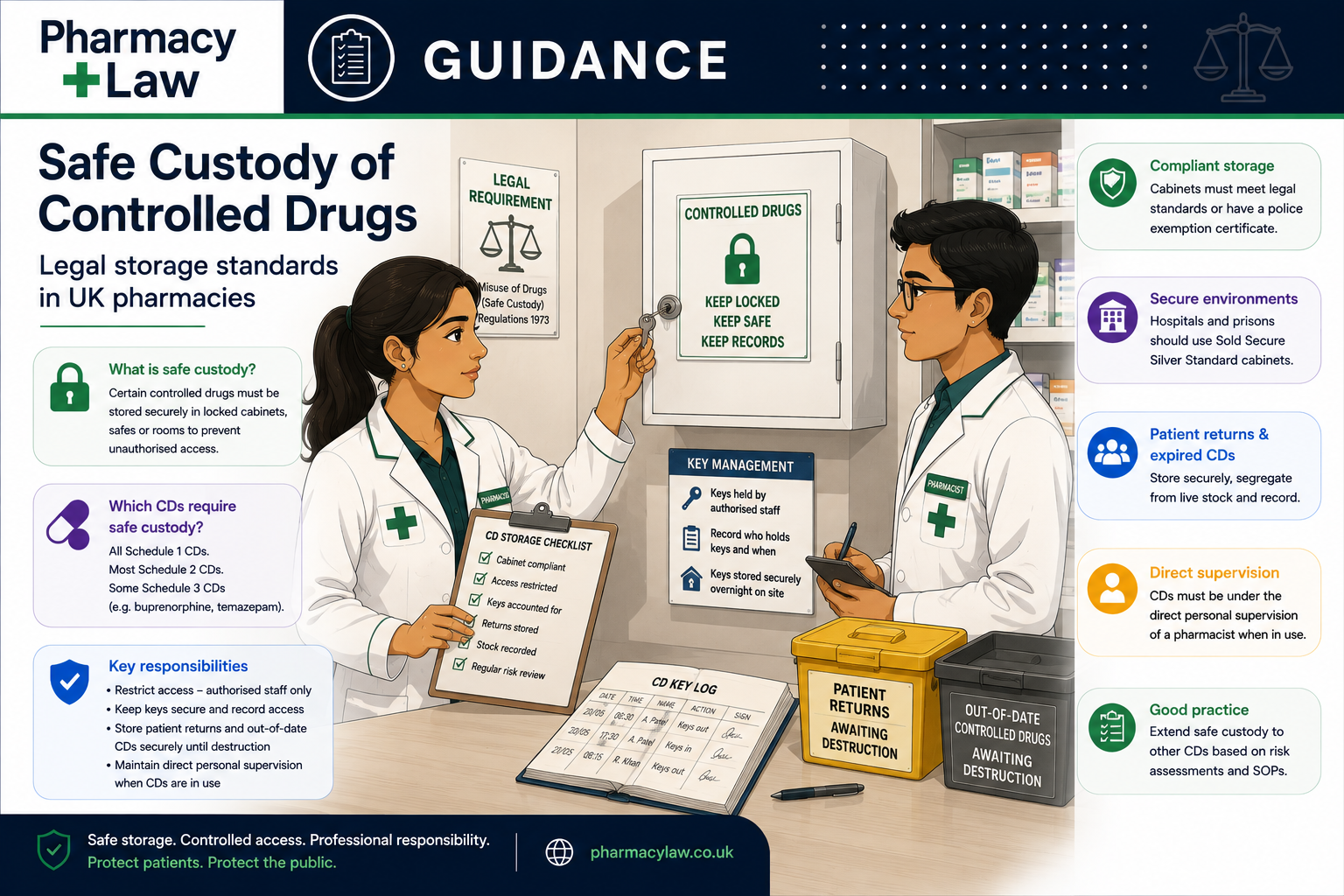
Safe Custody of Controlled Drugs

The Misuse of Drugs (Safe Custody) Regulations 1973 set legal standards for how certain Controlled Drugs (CDs) must be stored to prevent unauthorised access. This article outlines what is required by law, what is best practice, and how to manage CD storage in pharmacies, hospitals, and secure environments.

Safe custody refers to the physical security of CDs. Certain CDs must be stored in a locked safe, cabinet, or room that complies with security standards designed to prevent unauthorised access.

The requirement applies to:

Controlled drugs

Collection or Delivery of Controlled Drugs for Patients

Pharmacies in the UK must follow specific legal and professional standards when supplying Controlled Drugs (CDs), especially those in Schedule 2. This article outlines what is legally required when a patient, representative, or healthcare professional collects a CD, as well as how home deliveries should be managed.

When a Schedule 2 CD is collected, the pharmacist is legally required under the Misuse of Drugs Regulations 2001 to determine who is collecting the medicine:

Actions must differ depending on who is collecting the medicine.

Controlled drugs

Requisition Requirements for Controlled Drugs

Pharmacy professionals must follow strict legal requirements when obtaining controlled drugs (CDs) for stock. This article outlines when a mandatory requisition form must be used to obtain Schedule 1, 2, or 3 CDs, and includes guidance on processing, exemptions, and special cases such as midwife supply orders.

From 30 November 2015, it became mandatory under the Misuse of Drugs Regulations 2001 for healthcare professionals in the community to use an approved requisition form when requesting Schedule 2 or 3 CDs.

This rule applies to requisitions for both human and veterinary use. It was introduced following the Shipman Inquiry to improve the audit trail and monitoring of controlled drug movement.

Controlled drugs

Controlled Drugs: Import, Export and Travelling – Legal Requirements for UK Pharmacies and Patients

Pharmacy professionals in the UK are often asked about the legal requirements around importing and exporting controlled drugs (CDs), both for pharmacy operations and for patients travelling internationally. The rules differ depending on the CD schedule and whether the movement is personal or commercial.

Pharmacies must hold a Home Office Controlled Drugs licence to import or export the following:

For Schedule 4 (Part II) controlled drugs, a Home Office licence is still required unless the drug is being imported or exported by an individual for self-administration.