This article is provided free of charge thanks to sponsorship by Pharmacy Mentor, a UK pharmacy marketing and web development agency that supports community pharmacies with websites, SEO, social media, online booking systems and wider digital marketing.
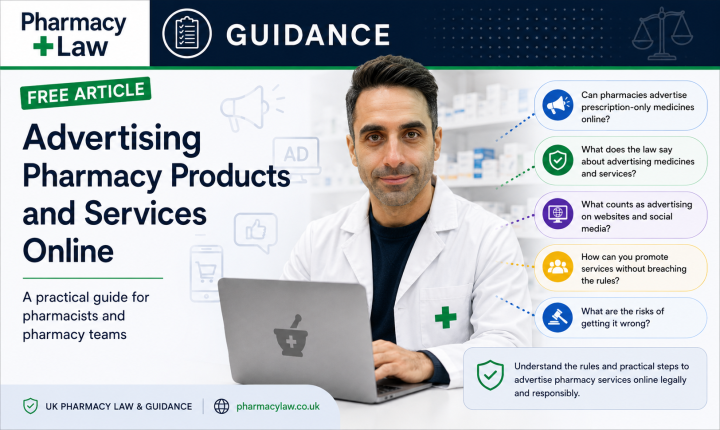
Pharmacy websites, Google listings, paid search adverts, Meta adverts, TikTok videos, Instagram posts and email campaigns can all be valuable ways to tell patients about pharmacy services. However, advertising pharmacy services online also creates legal and professional risks, especially where the service involves prescription-only medicines.
The key rule is simple:
Pharmacies can advertise pharmacy services, clinical services and over-the-counter medicines, but they must not advertise prescription-only medicines or prescription-only medical treatments to the public.
This distinction is particularly important for online services such as weight management, travel health, hair loss, erectile dysfunction, acne, contraception, migraine, menopause, period delay and private online prescribing services. A pharmacy may be able to advertise that it offers a consultation or clinical service, but it must not promote a particular prescription-only medicine to members of the public.
Why this matters
Online advertising is often public-facing. A social media post, Google ad, website homepage, sponsored post, influencer video or paid landing page may be seen by anyone. If that content promotes a prescription-only medicine, it may breach medicines advertising law and advertising rules.
This area has become especially important because many private pharmacy services involve medicines that are prescription-only medicines, including some medicines used for weight management, erectile dysfunction, acne, hair loss, contraception and travel health.
The Advertising Standards Authority has repeatedly made clear that prescription-only medicines and prescription-only medical treatments must not be advertised to the public under rule 12.12 of the CAP Code: https://www.asa.org.uk/type/non_broadcast/code_section/12.html
The MHRA also states that prescription-only medicines cannot be advertised to the general public: https://www.gov.uk/guidance/advertise-your-medicines
The legal basis
The main legal framework is Part 14 of the Human Medicines Regulations 2012, which deals with the advertising of medicinal products: https://www.legislation.gov.uk/uksi/2012/1916/part/14
Regulation 284 of the Human Medicines Regulations 2012 states that a person may not publish an advertisement that is likely to lead to the use of a prescription-only medicine: https://www.legislation.gov.uk/uksi/2012/1916/regulation/284
The MHRA explains the position in its guidance on advertising medicines. It states that over-the-counter medicines, including general sales list medicines and pharmacy medicines, can be advertised to the public, but prescription-only medicines cannot be advertised to the general public: https://www.gov.uk/guidance/advertise-your-medicines
The MHRA’s detailed guidance on advertising and promoting medicines is known as the Blue Guide: https://www.gov.uk/government/publications/blue-guide-advertising-and-promoting-medicines
The ASA and CAP Code also apply to many forms of advertising, including non-broadcast advertising, websites, paid search ads, social media posts and influencer marketing. CAP Code rule 12.12 states that prescription-only medicines or prescription-only medical treatments may not be advertised to the public: https://www.asa.org.uk/type/non_broadcast/code_section/12.html
What counts as advertising?
The Human Medicines Regulations define advertising broadly. Advertising is not limited to traditional adverts. It can include anything designed to promote the prescription, supply, sale or use of a medicinal product.
This means that a pharmacy should not assume that a post is safe simply because it is on social media or because it does not say “buy now”. Content may still be advertising if it promotes demand for a medicine or treatment.
Online advertising may include:
- a pharmacy website homepage;
- a service landing page;
- a Google search advert;
- a Facebook or Instagram advert;
- an organic social media post;
- a TikTok video;
- a YouTube video;
- an influencer post;
- an email campaign;
- a text message campaign;
- an affiliate marketing campaign;
- a paid directory listing;
- a blog article that promotes a medicine;
- before-and-after images used to sell a treatment;
- promotional claims about a treatment outcome;
- price promotions linked to a medicine.
The ASA has specific guidance on prescription-only medicines and the CAP Code here: https://www.asa.org.uk/news/prescription-for-compliance-poms-and-the-code.html
Prescription-only medicines must not be advertised to the public
Prescription-only medicines, often shortened to POMs, must not be advertised to the public.
This means that public-facing advertising should not promote a specific POM by name. It should also avoid wording, imagery or claims that are likely to lead the public to request or use a particular POM.
For example, a public advert should not say:
- “Buy Mounjaro online”
- “Wegovy weight loss pens available now”
- “Ozempic injections from £X”
- “Get Saxenda delivered”
- “Order Orlistat prescription capsules”
- “Prescription acne tablets available”
- “Get isotretinoin online”
- “Prescription migraine tablets delivered”
- “Private antibiotics without seeing your GP”
Even if the pharmacy is properly registered and the service includes a clinical consultation, the advert may still be unlawful if it promotes a prescription-only medicine to the public.
Advertising the service, not the medicine
A pharmacy may usually advertise the availability of a clinical service, provided the advert does not promote a prescription-only medicine.
For example, a pharmacy may be able to advertise:
- “Weight management service”
- “Private weight management consultation”
- “Acne consultation”
- “Hair loss consultation”
- “Erectile dysfunction consultation”
- “Travel health clinic”
- “Period delay consultation”
- “Contraception service”
- “Migraine consultation”
- “Online doctor service”
- “Private pharmacy consultation”
However, the wording must be handled carefully. The advert should focus on the service, assessment and professional advice, not on the supply of a named POM.
A safer style is:
“Our pharmacy offers a private weight management consultation. A clinician will assess your suitability and discuss appropriate options.”
A riskier style is:
“Lose weight with prescription injections. Order today.”
The first example promotes access to a professional service. The second is likely to be seen as promoting prescription-only treatment to the public.
Weight management adverts
Weight management advertising is currently one of the highest-risk areas.
Many injectable weight management medicines are prescription-only medicines. Public-facing adverts should not name or promote these medicines. The ASA has issued guidance and rulings on this area, including advice that POMs must not be advertised to the public: https://www.asa.org.uk/advice-online/weight-control-prescription-only-medicines.html
The ASA has also explained that CAP Code rule 12.12 prohibits adverts to the public for prescription-only medicines and prescription-only medical treatments: https://www.asa.org.uk/news/prescription-for-compliance-poms-and-the-code.html
Pharmacies should be cautious with phrases such as:
- “weight loss injections”;
- “weight loss pens”;
- “skinny jab”;
- “GLP-1 injections”;
- “weekly injection”;
- “appetite-suppressing injection”;
- named POMs;
- brand names;
- pack images;
- injection pen images;
- before-and-after claims linked to a prescription treatment.
Even where a POM is not named, wording and imagery may still be enough to imply a specific prescription-only treatment.
The placement of information matters.
A pharmacy’s homepage, social media feed, paid search advert or landing page reached from an advert is likely to be treated as public promotional material. These pages should not advertise prescription-only medicines.
The ASA has previously drawn a distinction between promotional advertising and certain factual information on an advertiser’s own website, but pharmacies should not rely on this distinction too casually. Homepages, paid landing pages and proactively promoted pages are much more likely to be treated as advertising.
The safest approach is:
- do not name POMs on the homepage;
- do not name POMs in paid search adverts;
- do not name POMs in social media adverts;
- do not name POMs in influencer content;
- do not use POM images in public-facing advertising;
- do not use POM brand names in promotional service headings;
- do not use price promotions for named POMs;
- keep any medicine-specific information factual, balanced, non-promotional and away from public promotional landing pages.
CAP guidance on prescription-only medicines and advertising is available here: https://www.asa.org.uk/news/prescription-for-compliance-poms-and-the-code.html
Paid search adverts
Paid search adverts are public advertising. A pharmacy should not use paid search adverts that promote a prescription-only medicine to the public.
This means that adverts should not use copy such as:
- “Buy [POM brand] online”
- “[POM brand] from £X”
- “Order prescription weight loss injections”
- “Prescription acne tablets delivered”
- “Get [POM brand] today”
Pharmacies should also take care with keywords, ad extensions, sitelinks and landing pages. Even if the advert text avoids a POM name, the overall advert may still be problematic if it is clearly designed to drive the public to request a specific POM.
A safer approach is to advertise the clinical service rather than the medicine:
- “Private weight management consultation”
- “Online acne consultation”
- “Travel health clinic”
- “Erectile dysfunction consultation”
- “Private pharmacy consultation”
The landing page should then explain the service, suitability assessment, risks, exclusions and clinical process without promoting a named POM to the public.
Social media adverts and organic posts
Social media content can be advertising even if it is not paid. A post on a pharmacy’s Facebook, Instagram, TikTok, LinkedIn or X account may be considered advertising if it promotes a medicine or service.
Pharmacies should be careful with:
- posts naming POMs;
- hashtags containing POM brand names;
- reels or TikTok videos showing POM packs or devices;
- “limited offer” claims for prescription treatments;
- patient testimonials about POM outcomes;
- before-and-after photos linked to prescription treatment;
- influencer posts;
- paid collaborations;
- affiliate marketing;
- discount codes for prescription treatments.
If an influencer or third-party marketer promotes a pharmacy service, the pharmacy may still be responsible for the content. The ASA has guidance on influencers and advertising disclosure here: https://www.asa.org.uk/advice-online/recognising-ads-social-media.html
Over-the-counter medicines
Over-the-counter medicines can generally be advertised to the public, provided the advert complies with medicines advertising law and the CAP Code.
This includes:
- general sales list medicines;
- pharmacy medicines;
- authorised over-the-counter products.
However, adverts for OTC medicines must still be responsible, accurate and consistent with the product’s marketing authorisation and Summary of Product Characteristics or Patient Information Leaflet.
The MHRA states that over-the-counter medicines can be advertised to the public, but adverts must comply with the law and relevant guidance: https://www.gov.uk/guidance/advertise-your-medicines
The CAP Code rules on medicines, medical devices, health-related products and beauty products are available here: https://www.asa.org.uk/type/non_broadcast/code_section/12.html
OTC adverts should not:
- make misleading claims;
- exaggerate effectiveness;
- guarantee results;
- encourage unnecessary or excessive use;
- suggest that normal good health can be improved by taking a medicine;
- suggest that health could be affected by not taking the medicine;
- target children inappropriately;
- conflict with the product’s authorised indications.
Pharmacy services
Pharmacy services can generally be advertised, provided the advert is accurate, responsible and does not promote a POM to the public.
Examples of pharmacy services that may be advertised include:
- NHS Pharmacy First;
- flu vaccination;
- COVID vaccination;
- blood pressure checks;
- contraception service;
- travel health consultations;
- smoking cessation support;
- ear health services;
- weight management consultations;
- private online consultations;
- repeat prescription services;
- prescription delivery;
- medicines compliance support;
- minor illness advice;
- health checks.
However, advertising a service should not be used as a disguise for advertising a POM. For example, “weight management consultation” is different from “get prescription weight loss injections”.
Online pharmacy services and GPhC expectations
The General Pharmaceutical Council regulates registered pharmacies and pharmacy professionals.
The GPhC guidance for registered pharmacies providing pharmacy services at a distance, including on the internet, is available here: https://www.pharmacyregulation.org/pharmacies/registration-and-renewal/providing-services-online
The GPhC’s February 2025 guidance on registered pharmacies providing pharmacy services at a distance is available here: https://assets.pharmacyregulation.org/files/2025-02/gphc-guidance-registered-pharmacies-providing-pharmacy-services-distance-february-2025.pdf
The GPhC guidance focuses on patient safety, governance, accountability, prescribing safeguards, risk management and making sure medicines are clinically appropriate. It is particularly relevant for online prescribing services, high-risk medicines and services where patients access prescription medicines remotely.
Advertising should therefore be considered alongside the whole patient pathway. A pharmacy should not use marketing that creates pressure to obtain a medicine before a proper clinical assessment has taken place.
Professional standards and responsible advertising
Advertising should also comply with professional standards. Pharmacy owners and superintendent pharmacists should consider whether adverts are consistent with safe and effective care, patient-centred professionalism and public trust in pharmacy.
The GPhC standards for registered pharmacies are available here: https://www.pharmacyregulation.org/pharmacies/standards-and-guidance-pharmacies/standards-registered-pharmacies
The GPhC standards for pharmacy professionals are available here: https://www.pharmacyregulation.org/pharmacists/standards-and-guidance-pharmacy-professionals/standards-pharmacy-professionals
Advertising that is technically clever but clinically irresponsible may still create regulatory risk. For example, adverts that overstate benefits, minimise risks, encourage inappropriate demand, or target vulnerable patients may be problematic even if they avoid naming a POM.
Examples: likely compliant and likely risky wording
Weight management
Potentially safer:
“Our pharmacy offers a private weight management consultation. A clinician will assess your health, discuss suitable options and provide advice on safe weight management.”
Higher risk:
“Prescription weight loss injections available now.”
Likely problematic:
“Buy Mounjaro online today.”
Erectile dysfunction
Potentially safer:
“Private erectile dysfunction consultation available. Speak to a pharmacist about suitable options.”
Higher risk:
“Prescription ED tablets delivered discreetly.”
Likely problematic:
“Buy Viagra or Cialis online.”
Acne
Potentially safer:
“Acne consultation service available. Our clinicians can assess your symptoms and discuss suitable treatment options.”
Higher risk:
“Prescription acne tablets available.”
Likely problematic:
“Order isotretinoin online.”
Hair loss
Potentially safer:
“Hair loss consultation available. Speak to a clinician about possible causes and treatment options.”
Higher risk:
“Prescription hair loss tablets from £X.”
Likely problematic:
“Buy finasteride online.”
Travel health
Potentially safer:
“Travel health clinic. Book a consultation for travel advice, vaccines and malaria prevention.”
Higher risk:
“Prescription malaria tablets delivered.”
Likely problematic:
“Buy Malarone online.”
Do not use price promotions for POMs
Price promotions are particularly risky where prescription-only medicines are involved.
Pharmacies should avoid public-facing claims such as:
- “[POM] from £X”
- “20% off [POM]”
- “limited offer on weight loss injections”
- “cheapest [POM] online”
- “price match on [POM]”
- “free [POM] with consultation”
- “subscription plan for [POM]”
These claims are likely to promote demand for the medicine itself, rather than simply informing the public about a clinical service.
If pricing information is included on a website, it should be considered carefully and should not be used in a way that promotes a named POM to the public.
Testimonials and before-and-after images
Testimonials can create risk, especially where they relate to prescription treatments.
A patient testimonial saying that a named POM caused weight loss, improved skin, improved sexual performance or produced another clinical outcome is likely to be promotional.
Before-and-after images are also risky. They may imply a guaranteed or typical result, may encourage inappropriate demand, and may indirectly promote a prescription-only treatment even where the medicine is not named.
Pharmacies should be particularly cautious with:
- weight loss before-and-after photos;
- acne transformation photos linked to prescription treatment;
- hair regrowth images linked to prescription treatment;
- claims about rapid results;
- patient stories that identify or imply a POM;
- influencer testimonials.
Disease awareness and health information
Disease awareness material can be lawful, but it must not be a disguised advert for a prescription-only medicine.
A pharmacy may publish educational content about a condition, such as obesity, acne, erectile dysfunction, contraception or travel health. However, if the content leads the public towards a particular POM, it may be treated as advertising.
A disease awareness article is more likely to be acceptable where it:
- focuses on the condition rather than a medicine;
- presents balanced information;
- discusses lifestyle, self-care and non-medicinal options where relevant;
- does not name or promote a POM;
- does not include calls to action to request a specific medicine;
- does not use medicine images, brand colours or implied product references;
- directs patients to appropriate professional advice.
The MHRA Blue Guide should be checked where there is uncertainty: https://www.gov.uk/government/publications/blue-guide-advertising-and-promoting-medicines
Advertising to healthcare professionals
The rules are different where advertising is directed only at healthcare professionals or others qualified to prescribe or supply medicines.
The MHRA states that prescription-only medicines cannot be advertised to the general public, but can be promoted to healthcare professionals and others who can prescribe or supply the product: https://www.gov.uk/guidance/advertise-your-medicines
However, this does not mean that a public pharmacy website can freely advertise POMs simply because some healthcare professionals may see it. If POM information is intended for healthcare professionals, access and targeting should be controlled appropriately.
Practical checklist for pharmacy advertising
Before publishing online advertising, pharmacy owners should ask:
- Is the advert public-facing?
- Does it name a prescription-only medicine?
- Does it imply a specific prescription-only medicine?
- Does it use images of POM packs, injection pens or devices?
- Does it include price promotions for POMs?
- Does it use “buy now”, “order now” or similar language linked to a POM?
- Does it promote a clinical service rather than a medicine?
- Is the advert accurate, balanced and not misleading?
- Is the landing page compliant as well as the advert?
- Would the advert create pressure on a patient to request a particular medicine?
- Is the advert consistent with GPhC standards and patient safety?
- Has someone clinically and legally competent reviewed the advert before publication?
Suggested internal approval process
A pharmacy offering online services should have an internal process for approving advertising before it goes live.
This may include:
- identifying whether the service involves POMs;
- checking the proposed advert against CAP Code rule 12.12;
- checking MHRA guidance and the Blue Guide;
- reviewing the landing page, not just the advert;
- checking social media captions, hashtags and images;
- checking influencer or third-party content;
- keeping a copy of approved wording;
- recording who approved the advert;
- reviewing adverts periodically;
- removing outdated or non-compliant adverts quickly.
This is especially important where marketing is outsourced. A marketing agency can help with design, SEO, social media and campaigns, but the pharmacy owner remains responsible for ensuring that pharmacy advertising is lawful, safe and professionally appropriate.
Summary
Pharmacies can advertise their services online, but they must not advertise prescription-only medicines or prescription-only medical treatments to the public.
The safest approach is to promote the pharmacy service, not the medicine. Public-facing adverts should focus on professional assessment, suitability, advice and access to care. They should avoid naming POMs, showing POM images, using POM-related price promotions, or using wording that encourages the public to request a specific prescription medicine.
The main legal source is Part 14 of the Human Medicines Regulations 2012, especially regulation 284. The MHRA Blue Guide and the CAP Code provide practical rules and guidance, while the GPhC expects online pharmacy services to be safe, properly governed and patient-centred.
Online marketing can be valuable for pharmacies, but it should be designed around the legal boundary between advertising a healthcare service and unlawfully promoting a prescription-only medicine.