Controlled drugs Emergency supply of medicines Pharmacist and technician responsibilities Prescription requirements Safe dispensing practices

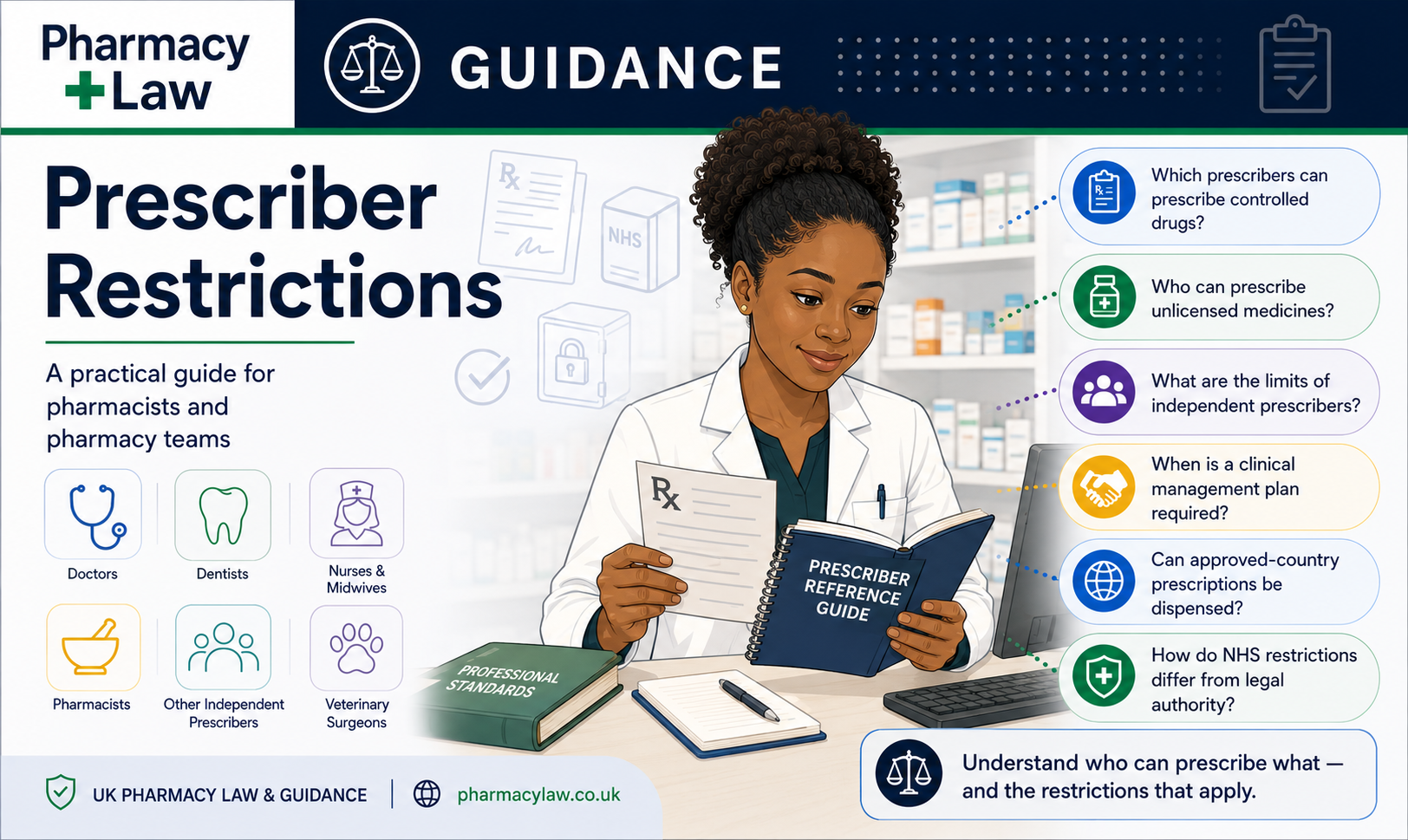
Prescriber restrictions

Doctors, dentists and veterinary surgeons acquire prescribing powers through their professional registration, although doctors must also hold a licence to practise. They have been joined by independent and supplementary prescribers from several other healthcare professions who may prescribe after completing an approved education programme and obtaining the relevant annotation on their professional register.

The existence of a legal prescribing power does not mean that a prescriber may appropriately prescribe every medicine. All prescribers must:

This article summarises the principal legal restrictions applying to each prescriber group.

Controlled drugs Emergency supply of medicines Patient group directions (PGDs) Pharmacist and technician responsibilities Record-keeping requirements

Emergency Supply of Medicines

Emergency supply allows a pharmacist to provide a medicine without a prescription in defined circumstances. It is a statutory exemption under UK medicines law and is commonly used in community pharmacy to ensure continuity of care.

Emergency supply is governed by the Human Medicines Regulations 2012:

https://www.legislation.gov.uk/uksi/2012/1916/contents

Controlled drugs Emergency supply of medicines Pharmacy premises standards Prescription requirements Safe dispensing practices

Faxed and Digital Prescriptions

Pharmacies are frequently presented with faxed prescriptions, emailed copies, or photos on a patient’s phone. While these may appear convenient, they raise important legal and patient safety issues.

This article explains what is and is not legally valid, and how pharmacists should approach these situations.

Under the Human Medicines Regulations 2012:
https://www.legislation.gov.uk/uksi/2012/1916/contents