
Advertising and promotion of medicines Controlled drugs Medicines licensing Over-the-counter (OTC) medicines Pharmacist and technician responsibilities Pharmacy inspections and enforcement Pharmacy premises standards Remote and online pharmacy services Safe dispensing practices

Selling codeine and dihydrocodeine Pharmacy medicines

Certain medicines containing codeine or dihydrocodeine may be sold without a prescription as Pharmacy medicines. However, these medicines are opioids with recognised risks of dependence, misuse and overdose. Combination analgesics may also cause serious harm through excessive consumption of their other ingredients, such as paracetamol or ibuprofen.

Pharmacy owners, responsible pharmacists and other pharmacy professionals must therefore ensure that requests are appropriately assessed and that these medicines are supplied safely.

The legal position comes from several sources:
Controlled drugs Pharmacy inspections and enforcement Pharmacy premises standards Record-keeping requirements

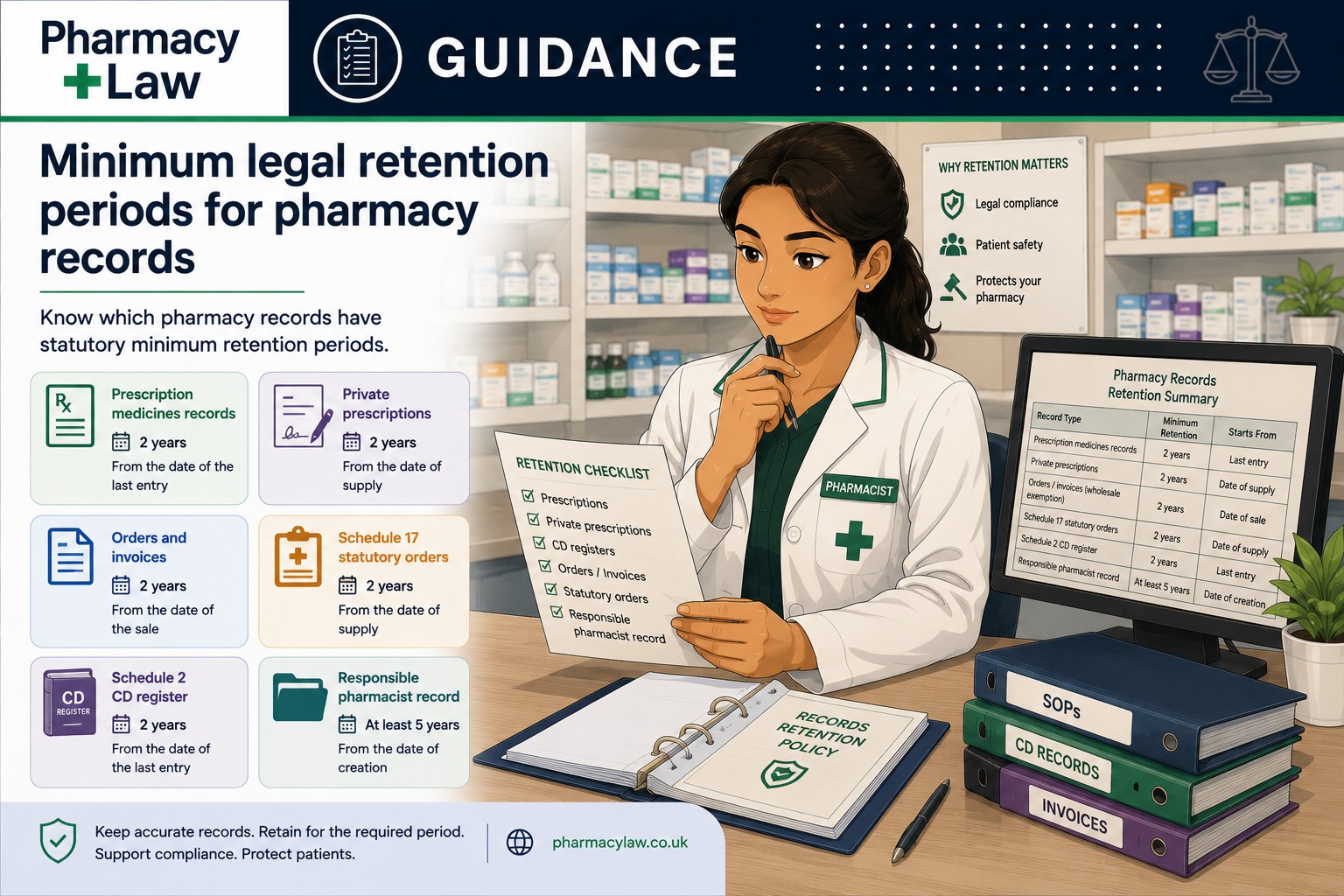
Minimum legal retention periods for pharmacy records

Pharmacies create and retain many different records, including prescriptions, patient medication records, controlled drug registers, responsible pharmacist records, clinical service records, invoices, SOPs and records of interventions.

Not every pharmacy record has a specific statutory retention period.

This article identifies records for which primary legislation expressly establishes a minimum retention period. It does not include periods based solely on professional guidance, NHS policy, contractual requirements, limitation periods or recommended practice.

Controlled drugs Pharmacist and technician responsibilities Pharmacy inspections and enforcement Pharmacy premises standards Record-keeping requirements Safe dispensing practices

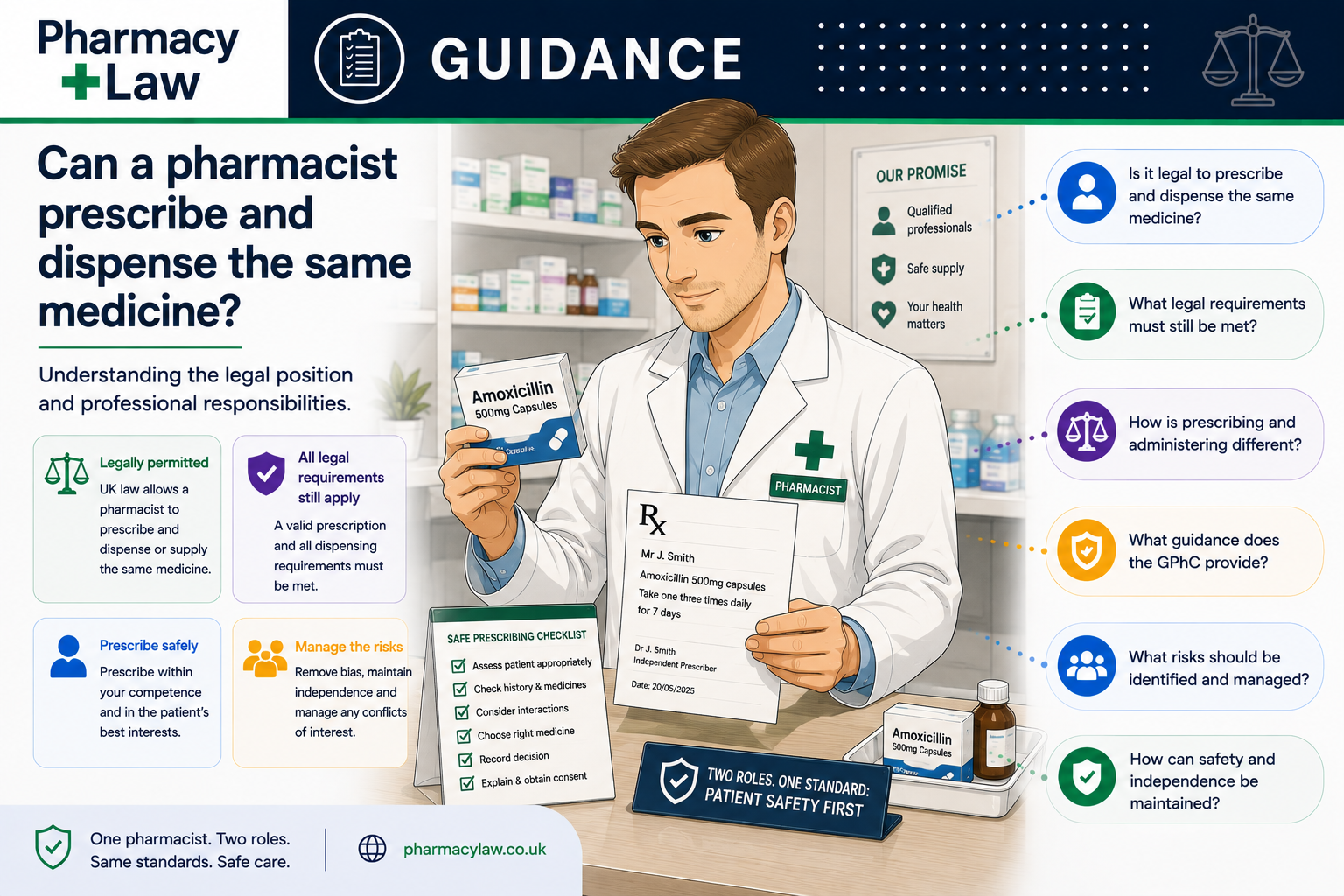
Can a pharmacist prescribe and dispense the same medicine?

Pharmacist independent prescribers increasingly provide services in which they assess a patient, prescribe a medicine and arrange for it to be dispensed or supplied from the same pharmacy.

In some services, the pharmacist prescriber may personally undertake every stage. They may assess the patient, make the prescribing decision, generate the prescription, clinically check it, dispense or accuracy-check the medicine and then supply or administer it.

UK medicines legislation does not establish a general requirement that prescribing and dispensing must be undertaken by different healthcare professionals. A pharmacist may therefore prescribe and dispense or supply the same medicine, provided that each activity is lawful and the service is delivered safely.

Handling complaints and patient safety Pharmacist and technician responsibilities Pharmacy inspections and enforcement Safe dispensing practices

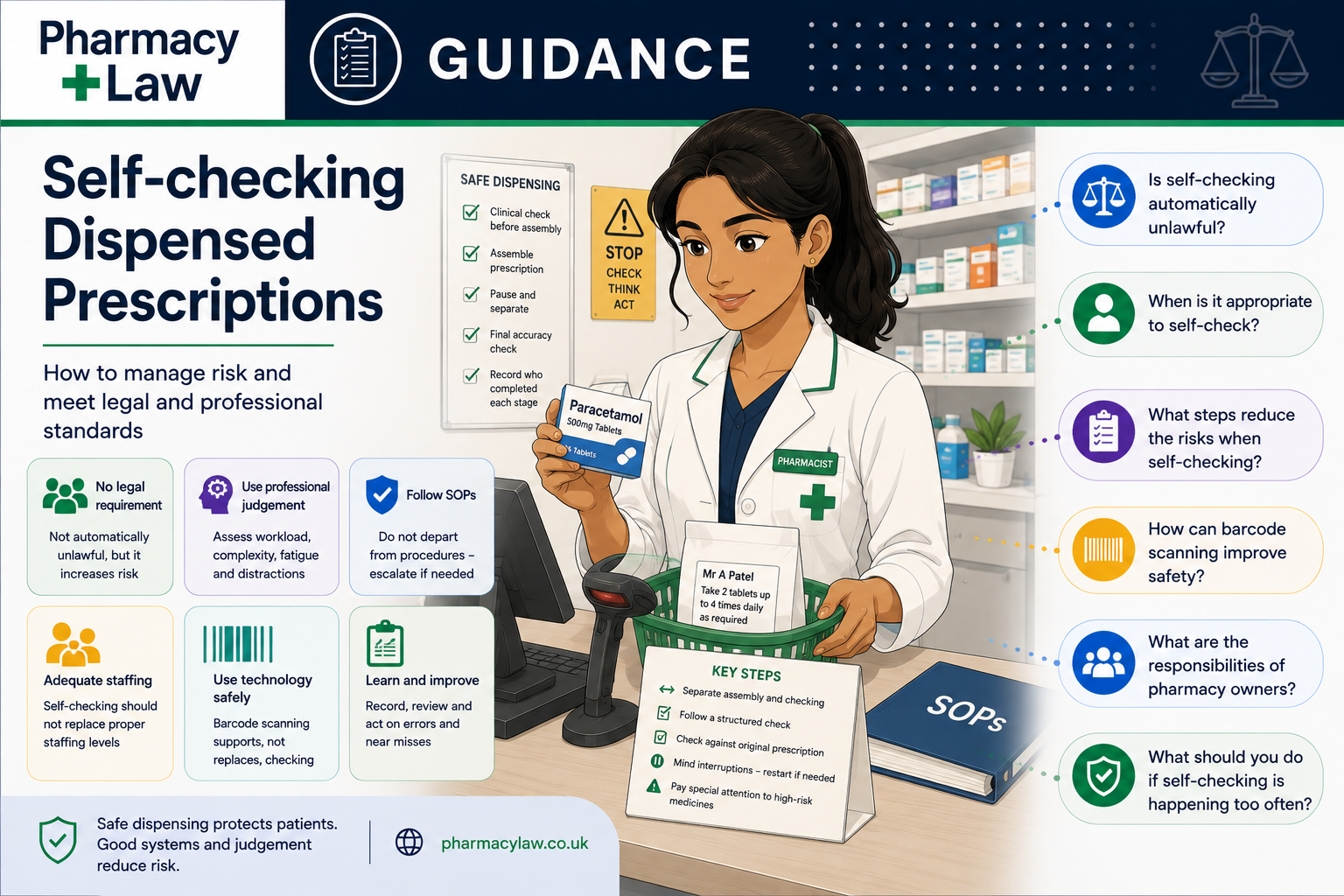
Self-checking dispensed prescriptions

Self-checking occurs when the same pharmacy professional assembles a prescribed medicine and subsequently carries out its final accuracy check.

Using a different competent person to undertake the final accuracy check provides an additional degree of independence. However, neither medicines legislation nor the General Pharmaceutical Council’s standards establish an absolute requirement that two different people must be involved in every dispensing process.

Self-checking is therefore not automatically unlawful. Nevertheless, it removes an independent opportunity to identify an error and should be treated as a dispensing risk that must be appropriately assessed and managed.

Pharmacist and technician responsibilities Pharmacy inspections and enforcement Pharmacy premises standards

Indemnity Insurance in Pharmacy

Indemnity insurance is a fundamental requirement for pharmacy professionals and pharmacy businesses in Great Britain. It provides financial protection where claims arise from professional practice and is a key component of patient safety and regulatory compliance.

Both individual registrants and pharmacy owners must ensure that appropriate indemnity arrangements are in place at all times.

The requirement for pharmacy professionals to have indemnity arrangements is set out in the
https://www.legislation.gov.uk/uksi/2010/231/contents
(Pharmacy Order 2010).

Controlled drugs Handling complaints and patient safety Pharmacist and technician responsibilities Pharmacy inspections and enforcement Pharmacy premises standards Record-keeping requirements Remote and online pharmacy services Safe dispensing practices

Online Pharmacies and Remote Prescribing

The growth of online prescribing and distance-selling pharmacy services has introduced significant risks around the safe and appropriate supply of medicines. In response, the General Pharmaceutical Council (GPhC) has strengthened its regulatory expectations for pharmacies operating remotely, particularly where prescribing is carried out online.

Pharmacy owners, superintendent pharmacists, and responsible pharmacists must ensure that any supply made through an online model meets both legal requirements and professional standards.

Registered pharmacies in Great Britain are regulated by the General Pharmaceutical Council under the Pharmacy Order 2010, which gives the GPhC enforcement powers over pharmacy owners, superintendent pharmacists, and pharmacy professionals.

Controlled drugs Pharmacist and technician responsibilities Pharmacy inspections and enforcement Pharmacy premises standards

Secure environments

Secure environments include prisons, police custody suites, secure hospitals, immigration removal centres, and other places where individuals are detained. These settings present unique legal and operational considerations because they sit at the intersection of healthcare law, custodial law, and medicines legislation.

UK medicines legislation (e.g. the Human Medicines Regulations 2012) does not always explicitly refer to these environments. In practice, pharmacy services must apply principles from primary care or secondary care, depending on the context, while remaining within the relevant legal framework.

Where medicines are dispensed from an in-house prison pharmacy for administration or supply to patients within the same prison: