Medicines licensing Over-the-counter (OTC) medicines Remote and online pharmacy services Safe dispensing practices

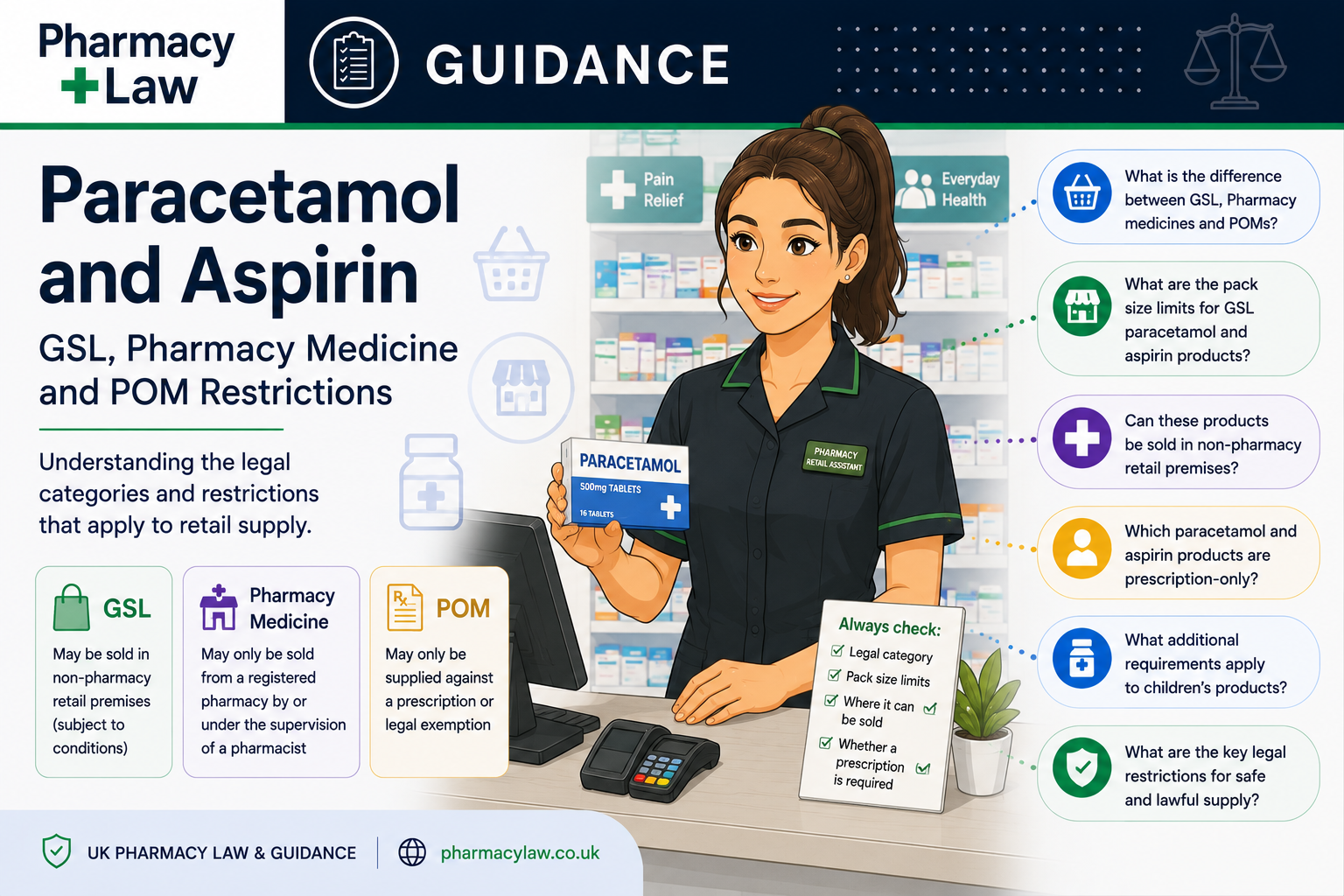
Paracetamol and aspirin: GSL, Pharmacy medicine and POM restrictions

Paracetamol and aspirin are familiar medicines, but their legal status is not always straightforward.

Some paracetamol and aspirin products can be sold from ordinary retail premises as General Sale List medicines. Some can only be sold from a registered pharmacy as Pharmacy medicines. Some products are prescription-only medicines. The correct legal category depends on the exact product, including its formulation, strength, pack size, marketing authorisation and presentation.

This matters because the legal category affects:

Medicines licensing Over-the-counter (OTC) medicines Pharmacist and technician responsibilities

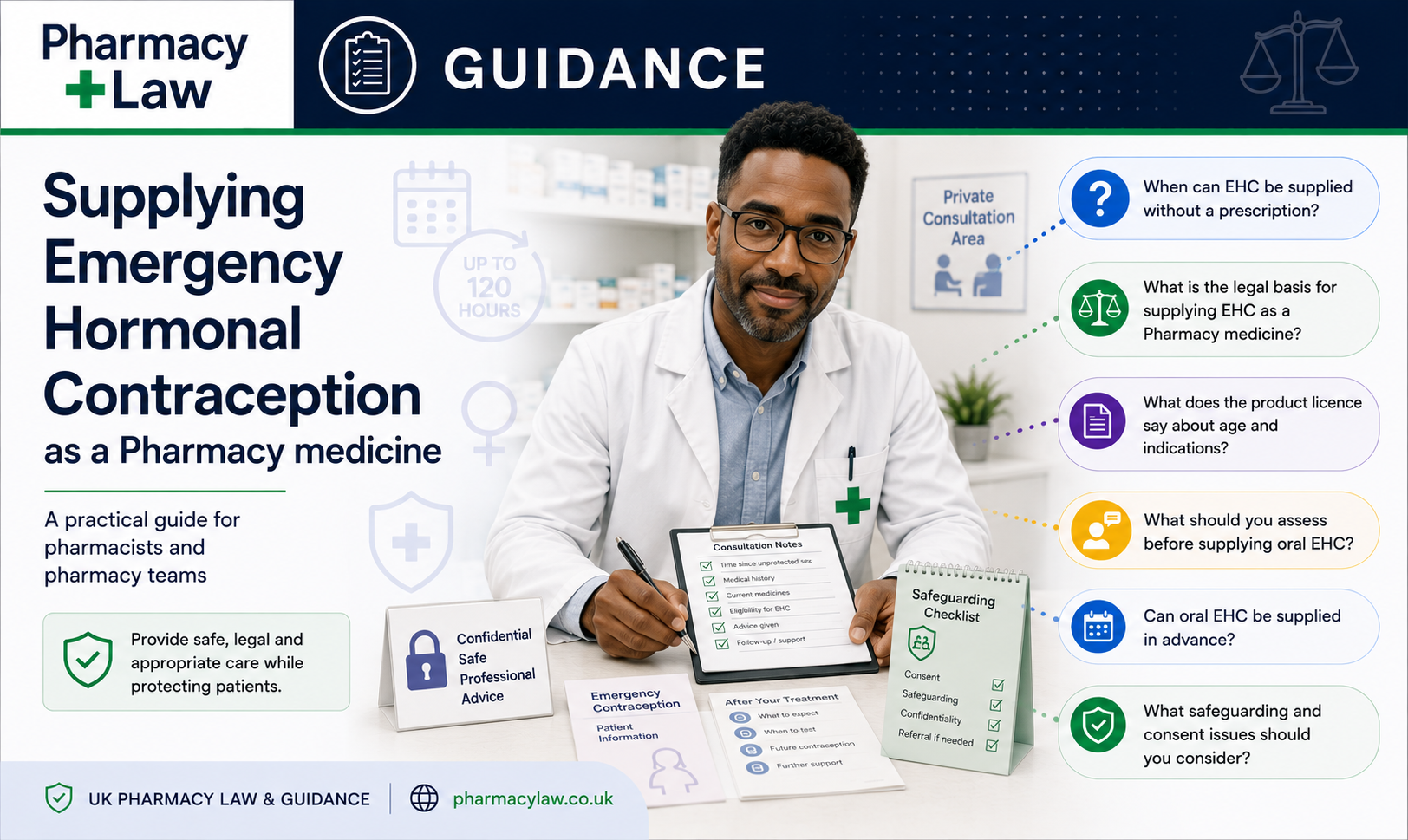
Supplying emergency hormonal contraception as a Pharmacy medicine

Emergency hormonal contraception, often abbreviated to EHC, can be supplied from a registered pharmacy without a prescription where the particular product is legally classified as a Pharmacy medicine.

The two principal oral emergency contraceptives are:

Although these medicines are available without a prescription, they are not general sale medicines. Their sale is subject to the legal controls applying to Pharmacy medicines and to the pharmacist’s professional assessment of whether the medicine is appropriate for the individual patient.

Medicines licensing Over-the-counter (OTC) medicines Pharmacist and technician responsibilities

General Sales List (GSL) Medicines

General Sales List (GSL) medicines are those that may be sold without the supervision of a pharmacist. They are intended for the treatment of minor conditions and are considered sufficiently safe for sale in a wide range of retail settings.

However, their supply is still governed by specific legal requirements under UK medicines legislation.

The legal framework for GSL medicines is set out in the Human Medicines Regulations 2012
https://www.legislation.gov.uk/uksi/2012/1916/contents

Controlled drugs Medicines licensing Over-the-counter (OTC) medicines Pharmacist and technician responsibilities Poisons and hazardous substances Safe dispensing practices

New Psychoactive Substances (NPS)

New Psychoactive Substances (NPS) are substances designed to produce psychoactive effects similar to controlled drugs but may not initially fall under traditional drug control laws. Their regulation in the UK is primarily governed by the Psychoactive Substances Act 2016.

Under the Psychoactive Substances Act 2016, a psychoactive substance is defined as a substance that:

“is capable of producing a psychoactive effect in a person”

Controlled drugs Over-the-counter (OTC) medicines Pharmacist and technician responsibilities Pharmacy premises standards Record-keeping requirements Safe dispensing practices

Supply or Collection of Medicines by Children

Pharmacists may be asked to supply or hand over medicines to a child or young person, either:

There is no absolute legal prohibition on a child collecting medicines. However, the decision to supply must be made using professional judgement, taking into account medicines legislation and regulatory standards.

Under the Human Medicines Regulations 2012, medicines may be supplied to a patient or their representative.

Medicines licensing Over-the-counter (OTC) medicines Pharmacist and technician responsibilities

Medicines licensing and marketing authorisations

In the UK, a medicinal product may only be sold or supplied in accordance with its marketing authorisation.

The marketing authorisation (also referred to as the product licence) sets out the legally binding conditions under which a medicine may be marketed, sold and supplied.

Compliance with a product’s marketing authorisation is a legal requirement under the Human Medicines Regulations 2012.

Medicines licensing Over-the-counter (OTC) medicines Pharmacist and technician responsibilities

Pseudoephedrine and ephedrine

Pseudoephedrine and ephedrine are active ingredients found in certain pharmacy (P) medicines, commonly used as decongestants.

Due to their potential use in the illicit manufacture of methylamphetamine (a Class A controlled drug), the sale and supply of pseudoephedrine- and ephedrine-containing medicines are subject to specific statutory restrictions under the Human Medicines Regulations 2012.

These restrictions apply in addition to the general legal requirements for pharmacy medicines.

Medicines licensing Over-the-counter (OTC) medicines Pharmacist and technician responsibilities Record-keeping requirements Safe dispensing practices

Pharmacy medicines (P)

Pharmacy medicines (P medicines) are medicinal products that may be sold or supplied only from registered pharmacy premises and only under the supervision of a pharmacist.

The legal classification, supply restrictions and supervision requirements for P medicines are set out in the Human Medicines Regulations 2012.

Under the Human Medicines Regulations 2012, a pharmacy medicine is a medicinal product that:

Over-the-counter (OTC) medicines Wholesaling

Wholesale supply of medicines: licence requirements

The wholesale supply of human medicinal products in the UK is governed primarily by the Human Medicines Regulations 2012 (as amended):
https://www.legislation.gov.uk/uksi/2012/1916

Under regulation 18 of the Human Medicines Regulations 2012, a person may not engage in the wholesale distribution of medicinal products unless they hold a wholesale dealer’s authorisation (WDA).

Wholesale distribution includes supplying medicinal products otherwise than to the public, where the supply is made by way of a business.