Medicines licensing Over-the-counter (OTC) medicines Remote and online pharmacy services Safe dispensing practices

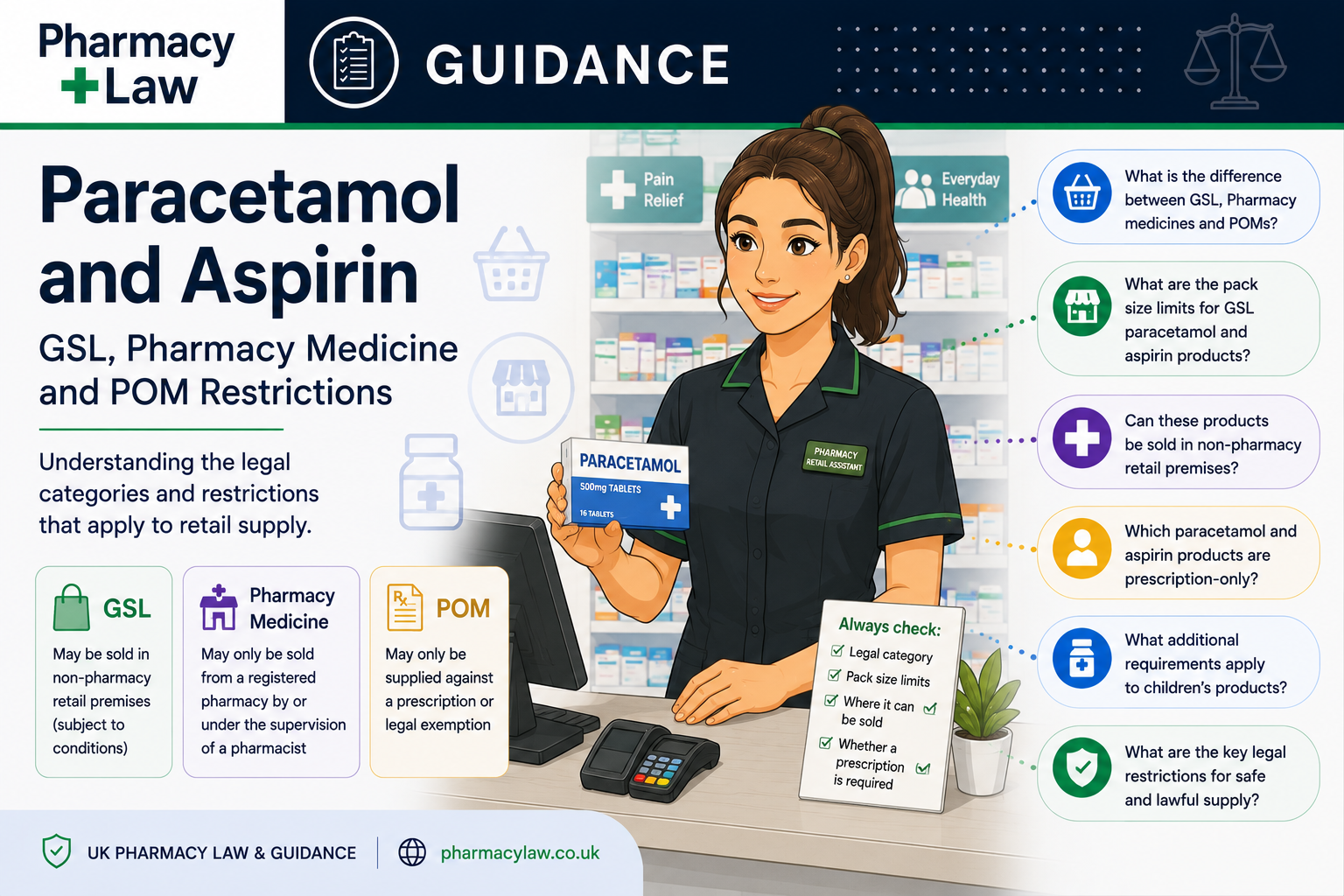
Paracetamol and aspirin: GSL, Pharmacy medicine and POM restrictions

Paracetamol and aspirin are familiar medicines, but their legal status is not always straightforward.

Some paracetamol and aspirin products can be sold from ordinary retail premises as General Sale List medicines. Some can only be sold from a registered pharmacy as Pharmacy medicines. Some products are prescription-only medicines. The correct legal category depends on the exact product, including its formulation, strength, pack size, marketing authorisation and presentation.

This matters because the legal category affects:

Medicines licensing Over-the-counter (OTC) medicines Pharmacist and technician responsibilities

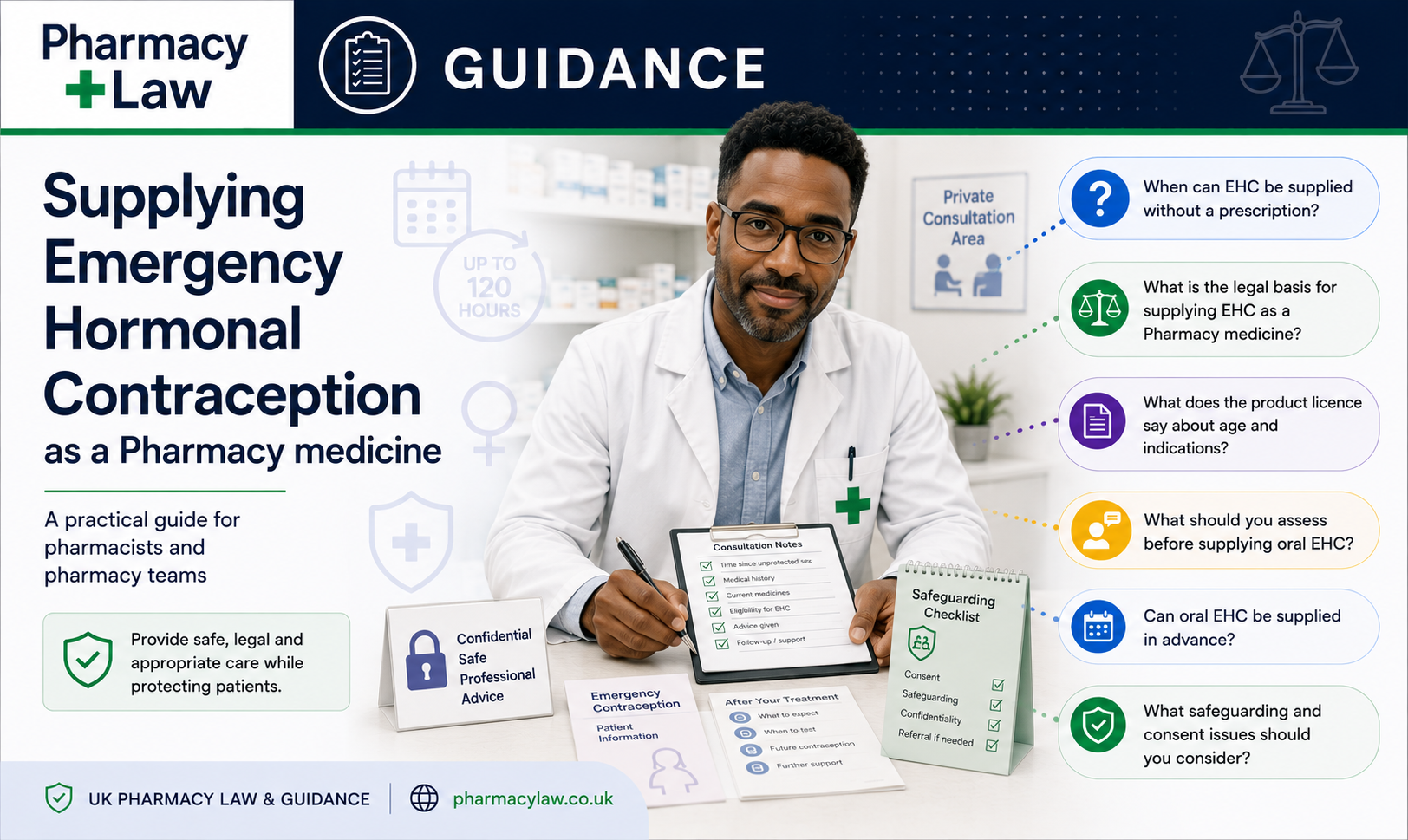
Supplying emergency hormonal contraception as a Pharmacy medicine

Emergency hormonal contraception, often abbreviated to EHC, can be supplied from a registered pharmacy without a prescription where the particular product is legally classified as a Pharmacy medicine.

The two principal oral emergency contraceptives are:

Although these medicines are available without a prescription, they are not general sale medicines. Their sale is subject to the legal controls applying to Pharmacy medicines and to the pharmacist’s professional assessment of whether the medicine is appropriate for the individual patient.

Medicines licensing Pharmacist and technician responsibilities Prescription requirements Safe dispensing practices

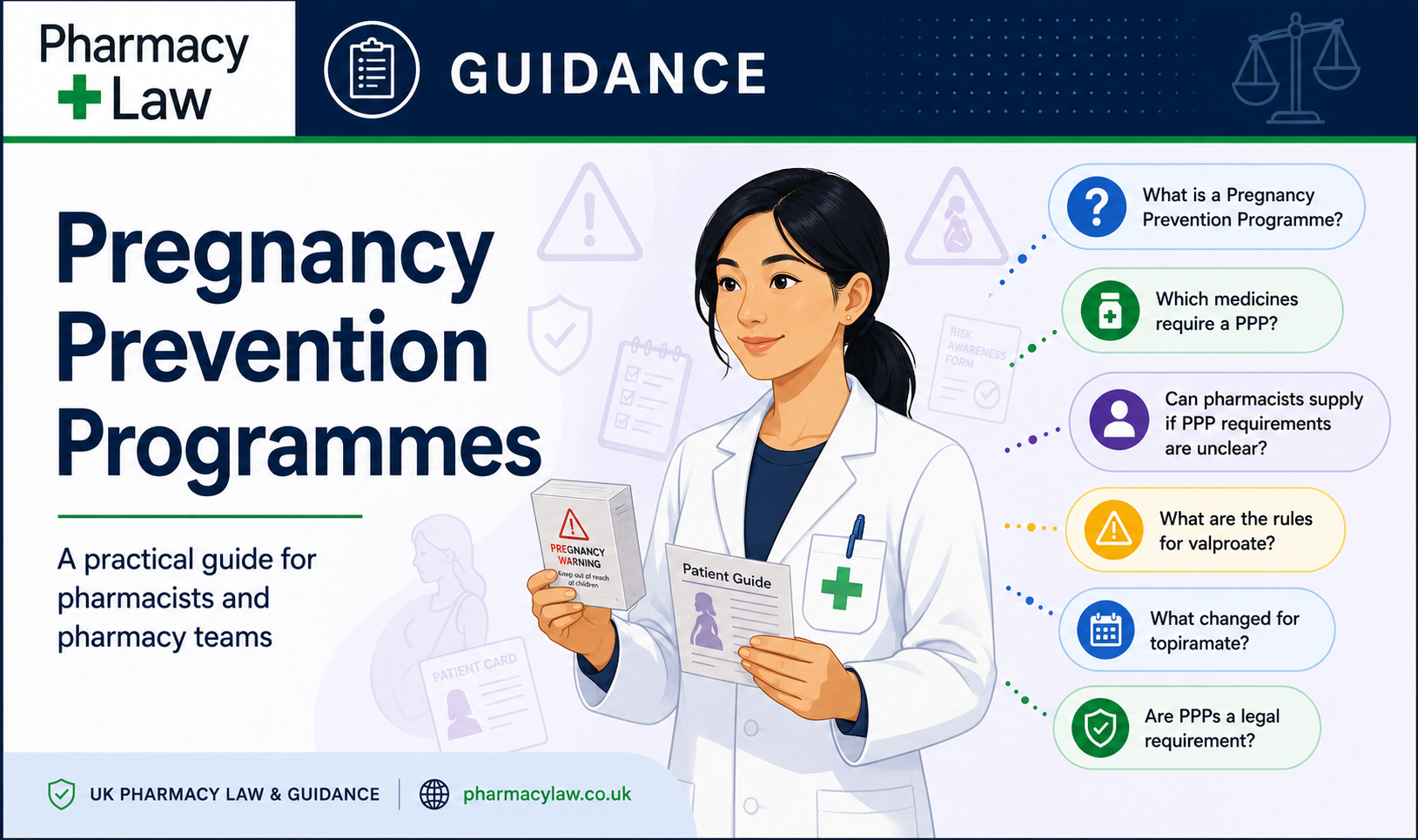
Pregnancy Prevention Programmes

Some medicines carry a high risk of causing serious harm if taken during pregnancy. These risks may include congenital malformations, neurodevelopmental disorders, foetal growth restriction, miscarriage or other serious harm to the unborn child.

Pregnancy Prevention Programmes, often shortened to PPPs, are regulatory risk minimisation measures designed to reduce the chance of pregnancy before, during and shortly after treatment with these medicines. They are particularly important for medicines known or suspected to be teratogenic, including oral retinoids, valproate, topiramate, thalidomide, lenalidomide and pomalidomide.

For pharmacy teams, the important legal and practical point is this: a PPP is not usually a standalone piece of legislation called a “pregnancy prevention law”. Instead, the requirement normally arises from the medicine’s marketing authorisation, Summary of Product Characteristics, Patient Information Leaflet and MHRA-approved risk minimisation materials. The MHRA describes Pregnancy Prevention Programmes as measures that may be put in place where a medicine has a known or potential teratogenic effect: https://www.gov.uk/government/publications/risk-minimisation-measures-for-medicines/risk-minimisation-measures-for-medicines

Medicines licensing

Prescription Only Medicines (POMs)

Prescription Only Medicines (POMs) are medicines that require authorisation from a qualified prescriber before they can be supplied. They are subject to the highest level of legal control due to their potential risks, complexity, or need for clinical oversight.

The legal framework for POMs is set out in the Human Medicines Regulations 2012
https://www.legislation.gov.uk/uksi/2012/1916/contents

A medicine is classified as a POM if it meets criteria such as:

Medicines licensing Over-the-counter (OTC) medicines Pharmacist and technician responsibilities

General Sales List (GSL) Medicines

General Sales List (GSL) medicines are those that may be sold without the supervision of a pharmacist. They are intended for the treatment of minor conditions and are considered sufficiently safe for sale in a wide range of retail settings.

However, their supply is still governed by specific legal requirements under UK medicines legislation.

The legal framework for GSL medicines is set out in the Human Medicines Regulations 2012
https://www.legislation.gov.uk/uksi/2012/1916/contents

Controlled drugs Medicines licensing Pharmacist and technician responsibilities Prescription requirements Safe dispensing practices

GnRH Analogues and Puberty Suppression

Gonadotrophin-releasing hormone (GnRH) analogues are used in clinical practice to suppress puberty. In the UK, their use in children and young people for gender incongruence or gender dysphoria is subject to specific legal restrictions.

Pharmacists must ensure they understand both the legislative framework and the practical implications for dispensing, particularly where prescriptions originate from private or non-UK prescribers.

The sale and supply of medicines in the UK is governed by the
https://www.legislation.gov.uk/uksi/2012/1916/contents
(Human Medicines Regulations 2012).

Controlled drugs Medicines licensing Over-the-counter (OTC) medicines Pharmacist and technician responsibilities Poisons and hazardous substances Safe dispensing practices

New Psychoactive Substances (NPS)

New Psychoactive Substances (NPS) are substances designed to produce psychoactive effects similar to controlled drugs but may not initially fall under traditional drug control laws. Their regulation in the UK is primarily governed by the Psychoactive Substances Act 2016.

Under the Psychoactive Substances Act 2016, a psychoactive substance is defined as a substance that:

“is capable of producing a psychoactive effect in a person”

Medicines licensing Pharmacist and technician responsibilities Pharmacy premises standards Safe dispensing practices

Medical Devices

Medical devices are regulated separately from medicines and are subject to a distinct legal framework in the UK. It is important to understand what qualifies as a medical device, how devices are classified, and the regulatory requirements that apply to their supply and use.

Under the Medical Devices Regulations 2002 (SI 2002/618) (as amended), a medical device is:

👉 Key legal distinction:
A medical device does not achieve its principal intended action by pharmacological, immunological, or metabolic means, although such means may assist its function.

Medicines licensing Safe dispensing practices

Expiry dates on medicines

Medicines are supplied with an expiry date that indicates the period during which the manufacturer guarantees the product’s quality, safety, and efficacy, provided it has been stored according to the recommended conditions.

Expiry dates are usually printed on the packaging as month and year (for example, EXP 06/2026). EU medicines legislation requires the expiry date to appear on the packaging in this format (month/year) under Directive 2001/83/EC.

Where the expiry date is expressed as month and year only, the medicine should be considered valid until the last day of that month.