Veterinary medicines

Supplying Veterinary Medicines Without a Prescription (UK Law)

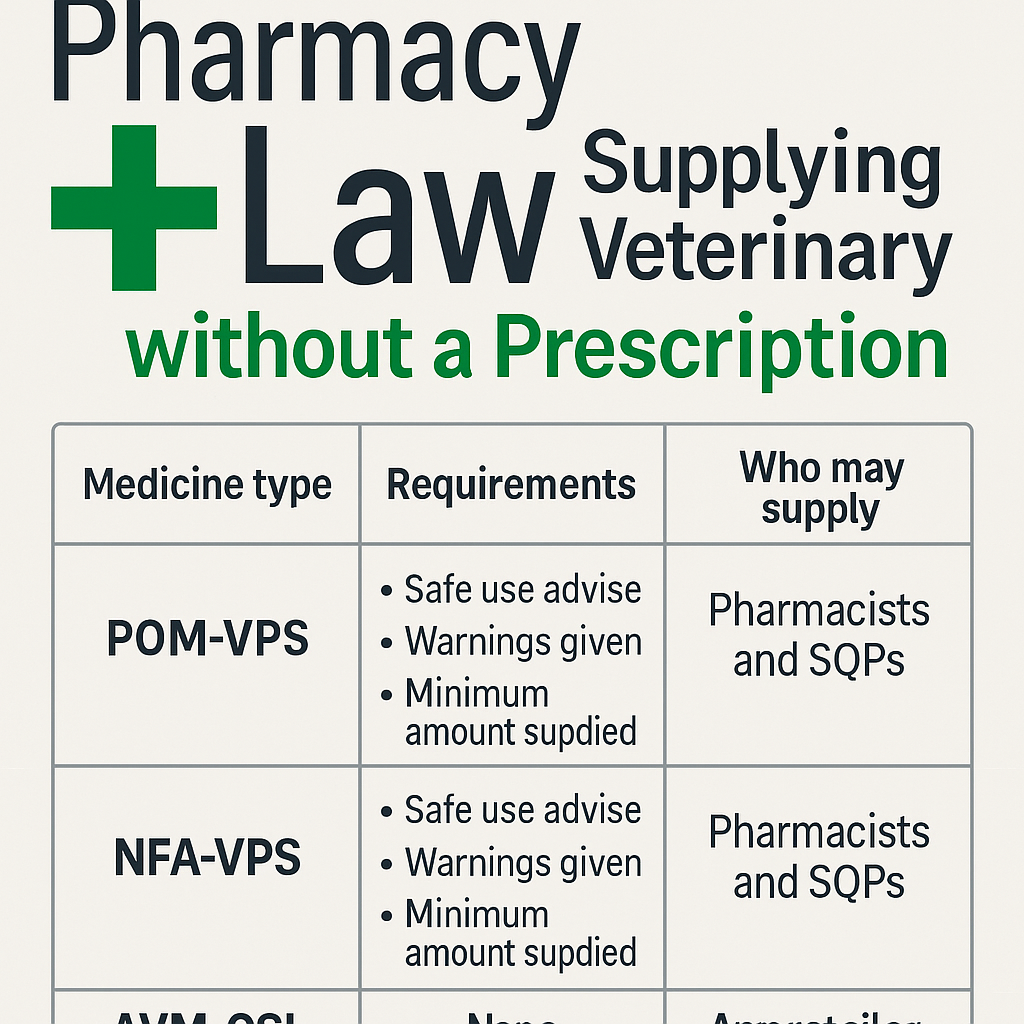
Under the Veterinary Medicines Regulations 2013 (VMR 2013) and Veterinary Medicines Directorate (VMD) guidance, veterinary medicines fall into four legal categories with specific supply rules:

NFA‑VPS medicines may be supplied without a prescription if the RQP (vet, pharmacist, or SQP):

These duties are outlined in RCVS guidance on NFA‑VPS supply ‎and confirmed in VMR 2013 Sch 3 para 3(4).

Advertising and promotion of medicines Veterinary medicines

Legal Requirements for Advertising Veterinary Medicines in the UK

The advertising of veterinary medicines in the United Kingdom is tightly regulated under the Veterinary Medicines Regulations 2013 (VMR), as amended, and guided by the Veterinary Medicines Directorate (VMD). These laws and guidelines ensure that any promotion of animal medicines is accurate, responsible, and directed only at appropriate audiences. Non-compliance with the VMR’s advertising rules is an offence, enforceable by the VMD (gov.uk). Below, we summarize the key legal requirements for advertising veterinary medicines – including what counts as an advertisement, the rules for advertising to the general public vs. to professionals, and special provisions for different medicine categories (POM-V, POM-VPS, NFA-VPS, AVM-GSL).

Under UK law, “advertising” of a veterinary medicine is defined very broadly. It includes any activity related to a veterinary product that is intended to promote the sale, supply, prescription or use of that product (gov.uk). This covers both direct and indirect promotion, whether done for profit or not. In practice, nearly any promotional communication about a vet medicine can be an advertisement, including:

Crucially, this definition applies equally to electronic media (websites, social media) as to traditional media (gov.uk). Even content like forum posts or social media content created by a company can count as advertising if it promotes a product. Customer testimonials used in marketing are also considered advertising claims of the company if they imply medicinal effects (gov.uk, gov.uk).
Record-keeping requirements Veterinary medicines

Record Keeping for Veterinary Medicines

Pharmacies supplying POM-V (Prescription Only Medicine – Veterinarian) and POM-VPS (Prescription Only Medicine – Veterinarian, Pharmacist, Suitably Qualified Person) medicines are legally required to keep certain records under the Veterinary Medicines Regulations 2013 (VMR 2013).

For each receipt and supply of a POM-V or POM-VPS medicine, the following details must be recorded:

All premises that retail POM-V or POM-VPS medicines must carry out an annual audit of stock and records, to ensure that:

Prescription requirements Veterinary medicines

Prescription requirements for veterinary medicines

This article explains the legal and best practice requirements for veterinary prescriptions in the UK, including those for POM-V, POM-VPS, and medicines prescribed under the veterinary cascade. The legal framework is primarily set out in the Veterinary Medicines Regulations 2013, with additional best practice guidance provided by the Veterinary Medicines Directorate (VMD) and the Royal College of Veterinary Surgeons (RCVS).

To be legally valid in Great Britain (England, Wales, and Scotland), a written veterinary prescription must contain the following information, in accordance with the Veterinary Medicines Regulations 2013 and RCVS guidance:

When prescribing Schedule 2 or 3 Controlled Drugs for animals, the following additional requirements must be met. These are outlined in the RCVS Controlled Drugs A–Z guidance and aligned with the Misuse of Drugs Regulations 2001: